Aholo 3DGS Viewer: Stream Massive Gaussian Worlds
A high-performance engine for billion-scale Gaussian Splatting with LOD streaming, physics collisions, and hybrid cloud rendering.
Introduction: The Evolution of 3D Web Rendering
For years, web-based 3D rendering was a compromise. We had to choose between the structural precision of texture-mapped triangle meshes or the photorealistic "vibe" of static 360-degree panoramas. The arrival of 3D Gaussian Splatting (3DGS) changed the game, offering a way to render scanned real-world environments with unparalleled fidelity.
However, as we move into 2026, users no longer want to just "see" a digital scan; they want to inhabit it. This requires a shift from viewing assets to navigating worlds.
Moving Beyond "Single Object" Demos
If you’ve explored 3DGS on the web, you’ve likely seen the "isolated object" phenomenon—a floating bicycle or a small garden rendered beautifully but disconnected from any larger context. While these make for great social media clips, they fall short of industrial and enterprise needs.
In some of our users’ work with large-scale spatial data, they’ve seen that the real challenge isn't rendering a few million splats; it’s rendering a billion. Whether it’s an entire historical site or a massive industrial facility, the web needs a viewer that doesn't crash when the scene exceeds a few hundred megabytes. This is the "Billion-Scale" barrier that the Aholo 3DGS Viewer was built to break.
The Convergence of Photorealism and Interactivity
Photorealism without interactivity is just a movie. Interactivity without photorealism is just a legacy CAD model. The future of the spatial web lies at the intersection of these two.
We are seeing a massive demand for "navigable photorealism"—the ability to walk through a scanned factory, check for collisions, and see high-fidelity machinery rendered alongside the atmospheric details of a 3DGS scan. The Aholo 3DGS Viewer represents this convergence, treating 3DGS not as a static image, but as a dynamic, queryable environment.
Technical Deep Dive: Inside the Aholo 3DGS Engine
To achieve what was previously thought impossible in a browser, Aholo didn't just build a wrapper around existing libraries. We re-engineered the 3DGS pipeline from the GPU up. The goal was simple but ambitious: create an engine that perceives the hardware it’s running on and scales its complexity accordingly.
High-Performance Rendering Architecture
At the heart of the Aholo 3DGS Viewer is a GPU-aware rendering architecture. Aholo uses granular parameters to balance performance and visual quality in real-time.
Whether you are targeting "Quality-First" for a desktop workstation or "Extreme-Performance" for a smartphone, the engine adapts its render pipeline. This involves optimizing how splats are sorted and blended, significantly reducing GPU memory overhead without sacrificing the characteristic "softness" and detail of Gaussian Splatting. By simplifying the pipeline at the driver level, we’ve managed to keep frame rates stable even as scene complexity spikes.
Large scale 3DGS LOD streaming: Rendering Billions of Gaussians
The "Billion-Scale" claim isn't just marketing—it’s a result of our Chunk-level Level-of-Detail (LoD) scheduling. In a traditional setup, the browser tries to load the entire 3DGS file before rendering. For a billion-point scene, that would mean a multi-gigabyte download and an immediate crash. Aholo uses a streaming strategy based on frustum priority. The world is divided into manageable chunks, and the engine only fetches and refines the data that is currently within the user's field of view.
- 10-Second Visibility: Our streamed batch fetching ensures that the first coarse view of a massive environment is available within 10 seconds, regardless of total file size.
- Dynamic Refinement: As you move, the engine transparently swaps lower-resolution splats for high-detail ones, allowing for seamless navigation across vast, real-world spaces that were previously too large for the web.
Physics Collision: Turning 3DGS into Interactive Spaces
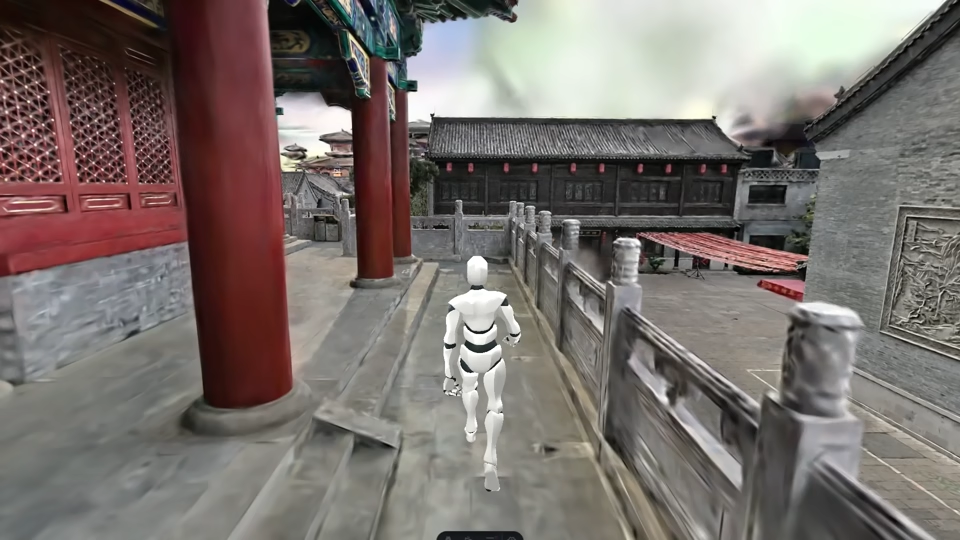
This is perhaps the most significant breakthrough in the Aholo engine. Historically, 3DGS has been "ghost-like"—you could see the walls, but you would walk right through them. Aholo changes this by generating queryable voxel colliders directly from the reconstructed 3DGS assets.
By turning raw Gaussian data into stable collision boundaries, we enable:
- Walk Mode: Users can walk on floors and be stopped by walls, just like in a game engine.
- Camera Obstacle Avoidance: No more clipping through the ceiling or getting stuck inside a scanned machine.
- Spatial Interaction: Real-time ray, capsule, and ground collision queries allow developers to trigger events or place UI elements precisely within the 3DGS environment.
Cloud Rendering Integration: 3DGS and High-Fidelity Mesh
Sometimes, the local hardware simply isn't enough, or the project requires a "Hybrid" approach. Aholo supports OpenUSD-based integration, allowing 3DGS and high-fidelity meshes to coexist in a single scene.
Through our Cloud Real-time Rendering pipeline, we can render these complex hybrid scenes on powerful remote servers and stream the result to a low-spec device. This is a game-changer for industrial applications where you need the atmospheric detail of 3DGS for the surroundings but the structural precision of Mesh for specific machinery or interactive parts. It’s a "what you see is what you get" composition that stays smooth on any device.
Experience the Future: Web and Mobile
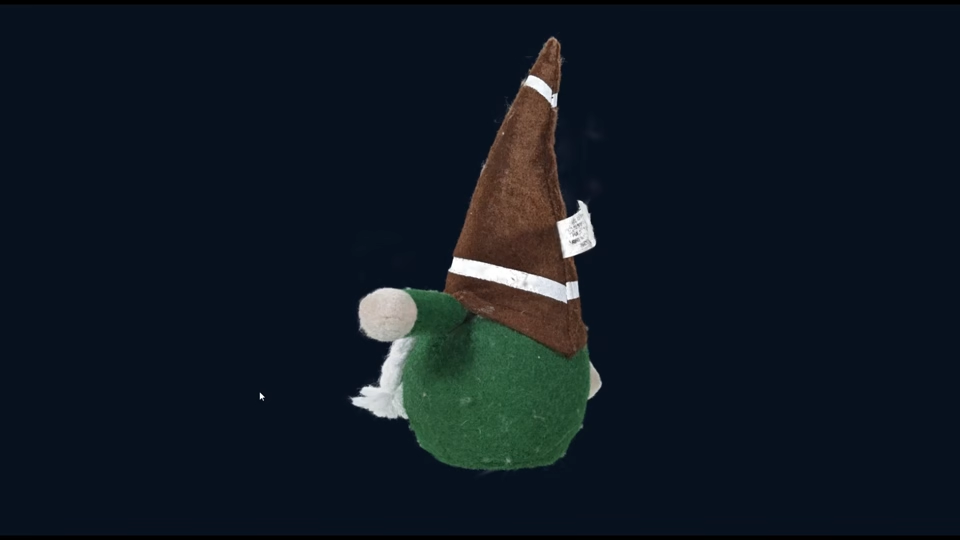
The true test of a 3D engine isn't just how it performs on a high-end workstation, but how it feels in the palm of your hand. Aholo was built with a "Web-First" philosophy, ensuring that massive spatial data is accessible to anyone with a browser, regardless of their hardware.
Large-Scale Real-World Environment Visualization
When we talk about "large-scale," we are referring to environments that capture the complexity of the physical world. Using Aholo, we've successfully visualized environments containing hundreds of millions to billions of Gaussian points.
In practical terms, this means you can explore an entire urban block or a multi-story warehouse without the stuttering or "pop-in" artifacts common in lesser viewers. The seamless transition between different levels of detail ensures that whether you are zooming in to inspect a specific texture or flying out for a bird's-eye view, the immersion remains unbroken.

Mobile Performance: Smooth Navigation on Any Device
Mobile browsers, particularly on iOS and Android, have strict limits on GPU memory allocation. Aholo’s GPU-aware optimizations were specifically designed to navigate these constraints.

By dynamically adjusting rendering presets—moving from high-fidelity to performance-optimized paths—Aholo keeps the experience smooth on smartphones. This opens up massive opportunities for field-based applications, such as:
- On-site project reviews using 3DGS scans on a tablet for real-time spatial verificatio.
- Immersive tourism and historical exploration accessible to millions via a simple URL.
- Instant cross-device previews that enable seamless navigation of high-detail 3DGS environments on any mobile browser, eliminating the need for high-end hardware or local app installations.
Open Source & Community
Aholo is more than just a proprietary engine; it is an open ecosystem designed to accelerate the adoption of 3D Gaussian Splatting across the web. By choosing an open-source model, we empower developers to move beyond experimentation and start building production-ready spatial applications.
Getting Started with Aholo SDK
The Aholo SDK is built for integration. Whether you are working within a established framework like THREE.js or building a custom 3D web application from scratch, the SDK provides the necessary hooks to get up and running quickly.
Under the MIT License, the Aholo engine is ready for everything from personal research projects to enterprise-level product extensions. This permissive licensing ensures that you own what you build, providing a stable foundation for the next generation of 3DGS tools, including custom viewers, editing suites, and interactive VR experiences.
Join the Ecosystem: GitHub and Documentation
We believe that great software is built through collaboration. Our entire development process is transparent and accessible through our community resources:
-
Aholo GitHub Repository: Access the source code, contribute to the core engine, or explore example validations that demonstrate how to implement complex features like LOD streaming and physics collisions.
-
Aholo Manual: A comprehensive guide for developers at any level. It covers everything from basic installation to advanced configuration of the rendering pipeline.
-
API Reference: For those who need deep control, our API documentation provides a detailed breakdown of every class, method, and parameter within the Aholo ecosystem.
Conclusion: Explore Your 3DGS Projects with Aholo Viewer and Build Your Next Spatial App
The shift from 2D images to 3D spatial environments is the next major frontier for the internet. However, this transition requires tools that are as robust as the real-world environments they represent. The Aholo 3DGS Viewer bridges the gap between raw data and immersive experience. By combining billion-scale LOD streaming, queryable physics collisions, and hybrid cloud rendering, we’ve created an engine that doesn't just display the world—it makes it interactive.
Whether you are building a digital twin of a smart city, an interactive historical archive, or a high-performance web game, Aholo provides the toolchain and the rendering power to bring your vision to life. The era of "visual-only" 3DGS is over; it's time to start building the spatial web.