Image to 3D Explained: Bridging Reality and Imagination with AI & 3DGS
Explore how Image to 3D technology works through 3D Gaussian Splatting (3DGS) and AI Spatial Generation. Learn how Aholo3D transforms photos and videos into immersive, interactive 3D spaces.
If you’ve ever tried to explain a complex interior design concept using only a flat mood board, you’ve felt the gap between a 2D image and a 3D reality.
For years, “Image to 3D” was a promise that either required:
- dozens of hours of manual CAD work
- or thousands of photos for photogrammetry reconstruction
Even then, the results often looked distorted, melted, or geometrically inconsistent.
But we are entering a new era.
The industry is moving beyond simple “reconstruction” and toward something much more powerful:
Spatial Intelligence.
At Aholo3D, we see this evolution happening through two complementary paths:
- capturing the real world with high fidelity using 3D Gaussian Splatting (3DGS)
- using AI to imagine and reconstruct full 3D environments from as little as a single image
Whether you want to create a digital twin of a real gallery or transform an AI-generated concept image into a navigable virtual space, understanding these two workflows is the first step toward choosing the right creative pipeline.
What Is Image to 3D? Two Professional Approaches
Today, “Image to 3D” no longer refers to a single algorithm.
The underlying technology changes completely depending on your input source.
For example:
- a room walk-through video
- versus a single conceptual image
require entirely different reconstruction logic.
Path 1: 3D Gaussian Splatting (The High-Fidelity Capture Workflow)
If your goal is to capture reality with maximum visual fidelity, traditional scanning methods often fall short.
This is where 3D Gaussian Splatting (3DGS) has become a major breakthrough.
How 3DGS Differs from Traditional Photogrammetry
Traditional photogrammetry converts reality into:
- polygon meshes
- flat surfaces
- UV textures
3DGS works differently.
Instead of triangles, it represents the world as millions of semi-transparent Gaussian splats.
You can think of it as a volumetric point cloud system where every point contains:
- color
- transparency
- depth
- lighting response
Because of this representation, 3DGS can naturally reproduce:
- reflections
- translucent materials
- soft shadows
- complex lighting
This is what gives 3DGS its cinematic realism.
Why Aholo3D Uses 3DGS
Cinematic Visual Quality
3DGS handles:
- glass
- reflective metals
- transparent objects
- indoor lighting
far better than traditional mesh-based reconstruction.
Faster Production Workflow
Users can simply:
- record a quick mobile scan
- upload the footage
- generate an immersive 3D scene
without going through a complicated reconstruction pipeline.
The New Digital Twin Standard
For commercial spaces, exhibitions, retail, and real estate, atmosphere matters as much as geometry.
3DGS excels at preserving that sense of space and realism.
Path 2: AI Spatial Generation (SpatialGen)
But what happens if there is no real space to scan?
What if all you have is:
- a conceptual render
- an AI-generated room
- a stylized illustration
- a single inspiration image
This is where AI Spatial Generation (SpatialGen) becomes essential.
AI Is Not Just Measuring Pixels — It Is Understanding Space
SpatialGen does not simply stretch an image into 3D.
Instead, it interprets architectural and spatial logic.
For example, the AI understands:
- where walls are likely positioned
- how lighting should behave
- how floors extend behind furniture
- how rooms are spatially connected
Rather than creating a shallow 3D relief, the system reconstructs an entire navigable spatial envelope.
Why SpatialGen Matters
Aholo3D SpatialGen helps designers rapidly move from:
- a static image
- to a spatial prototype
This is especially useful during:
- brainstorming
- concept development
- virtual staging
- pre-visualization
It allows creators to experience volume and scale before committing to expensive production or construction.
The Science of Spatial Intelligence
How does a computer look at a flat JPEG and understand depth?
It is not magic.
It combines:
- depth estimation
- geometric reasoning
- spatial topology prediction
into a unified reconstruction system.
How AI “Imagines” the Unseen
When humans look at a photo, we naturally fill in missing information.
We understand:
- tables usually have four legs
- floors continue beneath furniture
- rooms extend beyond the visible frame
SpatialGen works similarly.
The AI predicts hidden geometry based on architectural patterns learned from millions of real-world environments.
It estimates:
- wall placement
- floor continuity
- ceiling structure
- room proportions
to reconstruct a believable 3D environment.
Maintaining Visual Consistency
The hardest part of Image to 3D is not generating geometry.
It is preserving the “soul” of the original image.
Many AI systems produce spaces that lose:
- material identity
- lighting mood
- texture consistency
- color palette
Aholo3D focuses heavily on semantic and visual alignment.
The system attempts to preserve:
- original wood grain
- material properties
- lighting atmosphere
- color relationships
whether the source is:
- a real interior photo
- an AI render
- or a stylized fantasy environment
The Role of Text Prompts
Although the image itself remains the primary driver of reconstruction, text prompts can help guide interpretation.
For example:
If you upload a rough concept sketch and label it:
“Cyberpunk Laboratory”
the AI gains additional contextual understanding.
The text prompt does not directly define geometry.
Instead, it helps keep the AI’s imagination aligned with your creative intent.
Realistic Reconstruction vs Virtual World Creation
Image to 3D is not a single-purpose workflow.
The use case changes dramatically depending on where the image originates.
Scenario A: Realistic Reconstruction (Digital Twins)
Imagine an interior designer receives a single photo from a client asking:
“What would this room look like with an open-plan kitchen?”
Previously, this would require:
- manual measurements
- CAD modeling
- extensive reconstruction work
With Aholo3D SpatialGen, that single image can become a navigable spatial prototype.
It may not yet be millimeter-accurate CAD geometry, but it is already useful for:
- layout testing
- lighting studies
- furniture placement
- spatial exploration
It transforms a static image into an interactive environment.
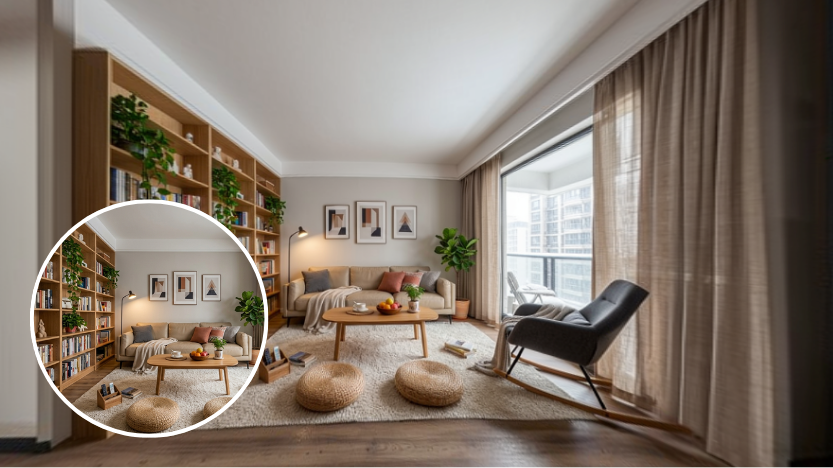
Scenario B: Virtual Concept Generation
For concept artists and virtual world creators, the goal is not to replicate reality.
It is to invent entirely new worlds.
Imagine generating:
- floating libraries
- surreal sci-fi interiors
- impossible architectural spaces
with AI image generation tools.
Traditionally, these ideas remained trapped in 2D.
Aholo3D SpatialGen helps creators step inside those imagined worlds.
The system interprets:
- stylized geometry
- impossible structures
- artistic spatial logic
and converts them into explorable 3D environments.
What once required weeks of environment modeling can now begin as a rapid spatial prototype.
Choosing the Right Workflow: 3DGS vs AI SpatialGen
The best workflow depends on:
- your input source
- your creative objective
| Feature | 3D Gaussian Splatting (3DGS) | AI SpatialGen |
|---|---|---|
| Input Source | Video walk-through | Single image |
| Primary Goal | High-fidelity reality capture | Rapid spatial prototyping |
| Visual Quality | Cinematic photorealism | Consistent with source image |
| Spatial Accuracy | Precise mapping | Estimated spatial volume |
| Best For | Real estate, exhibitions, commercial tours | Concept design, virtual staging, ideation |
FAQ
Can a single image really generate a full room?
Yes.
Although the AI cannot literally “see” behind furniture, it reconstructs the most likely room geometry using learned architectural patterns and spatial reasoning.
Is 3DGS better than traditional 3D scanning?
For visual realism, absolutely.
While LiDAR remains stronger for structural measurement accuracy, 3DGS is significantly better at capturing:
- atmosphere
- lighting behavior
- material realism
This makes it ideal for:
- marketing
- architecture visualization
- real estate
- immersive design presentation
Can these 3D environments be exported?
Yes.
Aholo3D is designed to integrate into professional workflows and supports export pipelines compatible with industry-standard platforms.
Conclusion: The Future of Multi-Modal 3D Creation
The boundary between “images” and “spaces” is disappearing.
At Aholo3D, we believe the future of design is not about choosing between reality and AI.
It is about combining both into a unified creative toolkit.
Whether you are:
- documenting reality with 3DGS
- or stepping inside conceptual imagery with SpatialGen
you are no longer limited by the flat surface of a screen.
You are building worlds.